Project 02
Flipper Robot,
Built to Fight.
A University of Bristol BEEES Robot Wars project where I worked on model development, 3D-printed structure, physical assembly, and competition preparation for a compact flipper robot.
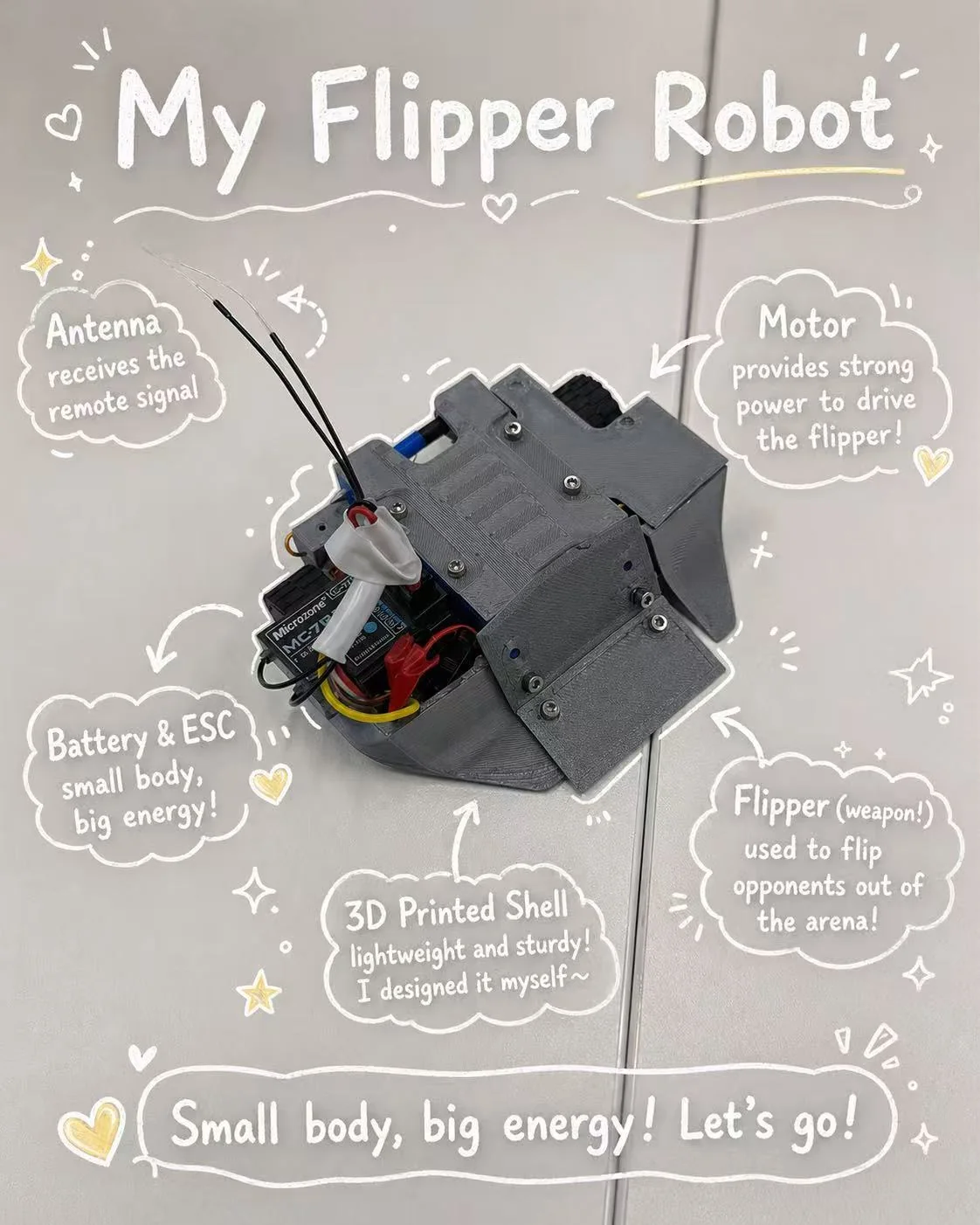
Final flipper robot: 3D-printed shell, exposed wiring, receiver antenna, battery/ESC packaging, drive motor, and front flipper weapon.
Engineering breakdown
The build was a packaging problem under pressure
From model development to a fightable physical object.
My work focused on turning a compact flipper concept into a printed, assembled, serviceable robot: shell geometry, component packaging, print-aware structure, assembly checks, and competition preparation.
Weapon and body layout
- Front flipper kept as the active fighting mechanism.
- Body shape had to leave space for motor, hinge area, shell, and electronics.
- Geometry was judged by whether it could survive contact, not only by appearance.
3D printed structure
- Printed shell balanced light weight with stiffness.
- Screw positions and access mattered during assembly.
- Physical fit checks exposed details that CAD alone could miss.
Electronics and serviceability
- Battery and ESC had to fit inside a small body without blocking movement.
- Receiver antenna and wiring needed enough exposure and strain relief.
- Repair access became important once the robot entered the arena.
Interactive model
150g Flipper Assembly
Drag to rotate. Scroll or pinch to zoom.
Build story
From CAD model to fight-ready robot
Define the fighting concept.
The robot uses a front flipper as the active weapon. The core design problem was packaging drive, battery, ESC, receiver, wiring, and the flipper structure inside a very compact body.
Model, print, and adjust.
I worked on model development and 3D-printable structure, then used physical assembly feedback to understand clearances, screw access, wall thickness, stiffness, and part fit.
Assemble under real constraints.
The final build made the tradeoffs visible: the robot needed to stay small, keep enough structural strength, protect electronics, and still leave serviceable access for wiring and maintenance.
Test it in competition.
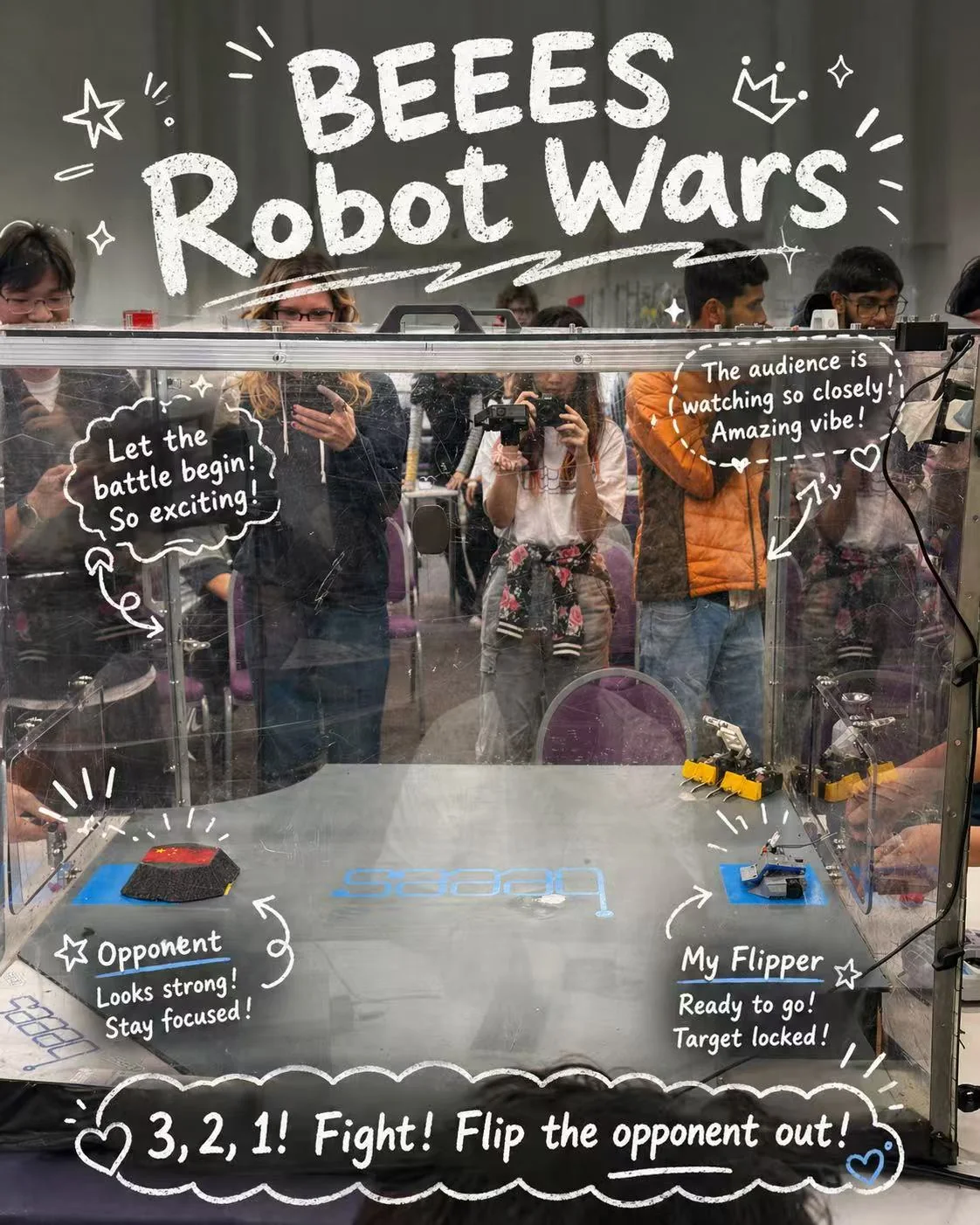
The BEEES Robot Wars arena turned the build into a real test: impact, reliability, weapon timing, driving control, and quick diagnosis mattered more than a clean CAD model alone.
Build in context
Small body, real arena
Iteration notes
What I would improve after the arena test
Add clearer covers or guards around exposed wiring and electronics while keeping enough access for quick repair between rounds.
Redesign fastener access so the top shell and flipper area can be opened with fewer steps during diagnosis and battery checks.
Use more structured drive and weapon tests before the event, so timing, traction, and flipper response are tuned before entering the arena.
Skills learned
What I learned from this project
Mechanical packaging under constraints
The project trained me to think beyond the outer shape: every screw, wire, receiver, battery, motor, and printed wall had to fit inside a small combat robot.
- Clearance and access for assembly, wiring, and maintenance.
- Balancing compactness, structural strength, and component protection.
- Understanding how CAD assumptions change after physical assembly.
Rapid prototyping and fabrication thinking
3D printing made design decisions immediately testable. I learned to treat modelling, fabrication, and assembly as one loop instead of separate tasks.
- Designing parts with printability and material behaviour in mind.
- Using assembled hardware to reveal problems that CAD cannot show clearly.
- Building confidence in moving from digital model to working object.
Competition feedback and engineering judgement
The competition environment turned the robot into a live engineering test, where reliability, control, repairability, and iteration speed became part of the design evaluation.
- Seeing how design choices behave under impact and pressure.
- Learning to diagnose problems quickly with limited time.
- Connecting mechanical design with electronics, control, and teamwork.